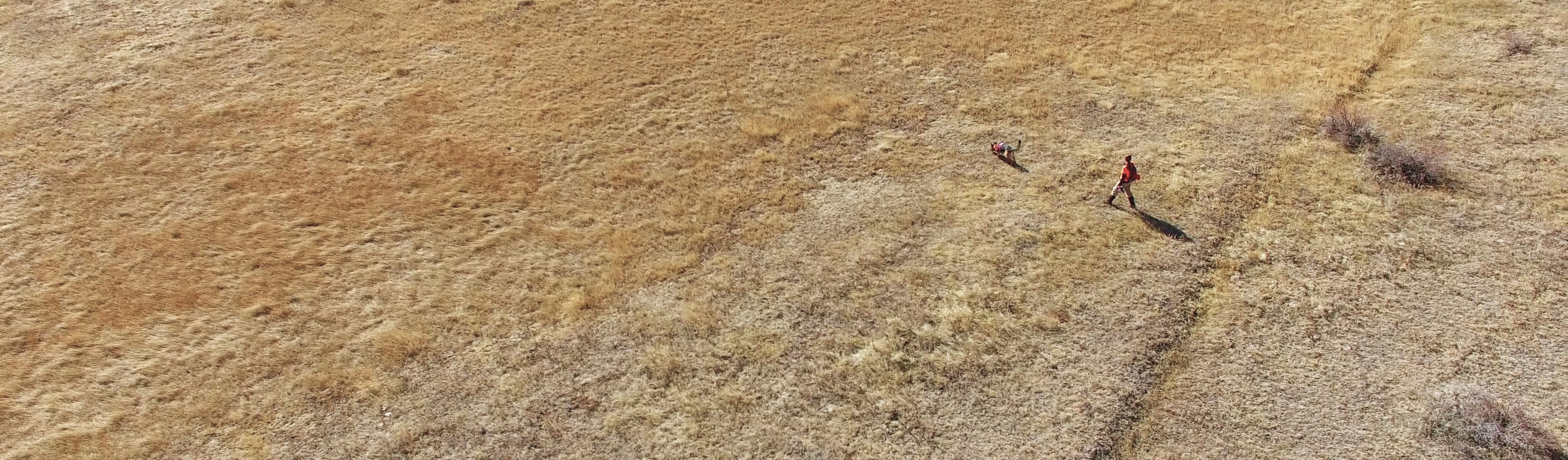
An aerial view of a dog and handler working across a dry autumn meadow.

Services

Overview

Our services are provided individually or combined depending on your project needs. Our work is non-invasive and is designed to support planning, survey, and cultural resource management processes.

Pre-project consultation

Review of your project's scope, site conditions, and survey approach to determine the suitability, logistics, and coverage strategy.

Pedestrian Survey

GPS tracking and sub-meter documentation of surface points such as depressions, markers, fence posts, or landscape elements often related to historic burials.

Detection Dog Survey

GPS tracking and sub-meter documentation of detection dog responses.

Aerial Imagery

High-resolution aerial photography of surveyed areas collected by an FAA Part 107 certified sUAS pilot.

GIS Analysis

Custom geospatial analysis to support site evaluation and survey planning.
  • Terrain modeling
  • Hydrology and drainage analysis
  • Soil and environmental overlays
  • Historic map and photo overlays
  • Probability mapping to prioritize areas of interest

Integration with Other Methods

Detection results can be used alongside:
  • Archival research
  • Geophysical survey (e.g., GPR)
  • GIS analysis
  • Archaeological investigation

Deliverables

Projects include documentation suitable for planning, consultation, and integration with CRM workflows.

Project Summary

Overview of the survey request, including project context, location, and objectives

Background Research

Summary of relevant historical or archival information, including materials provided by the client

Methods Overview

Description of survey approach, detection dog teams, and equipment used (GPS, drone platforms, and data processing methods)

Survey Mapping

  • GPS-tracked survey coverage with buffered search areas
  • Locations of detection alerts (TFRs)
  • Mapped features such as grave markers, vegetation, fencing, and other relevant site elements

Geospatial analysis (as needed)

Supporting analysis such as terrain, hydrology, or environmental factors used to inform interpretation

Interpretation of results

Integrated assessment based on detection, environmental context, and mapped data

Recommendations

Guidance for next steps, such as:
  • Additional investigative methods
  • Monitoring or avoidance

Data package (optional)

GIS-compatible files and spatial data for client use, further analysis, or integration with other project work
Typical Project Flow

  1. Project consultation and scope definition
  2. Background research compilation
  3. Field surveys
  4. Optional services (GIS analysis, aerial imagery, archival research)
  5. Mapping and documenation of results
  6. Delivery of report and spatial data

Limitations

Our services do not:
  • Involve excavation or subsurface testing
  • Confirm the presence of human remains
  • Make archaeological or regulatory determinations
All compliance decisions remain with qualified professionals and appropriate authorities.
An aerial view of a dog and handler working across a dry autumn meadow.