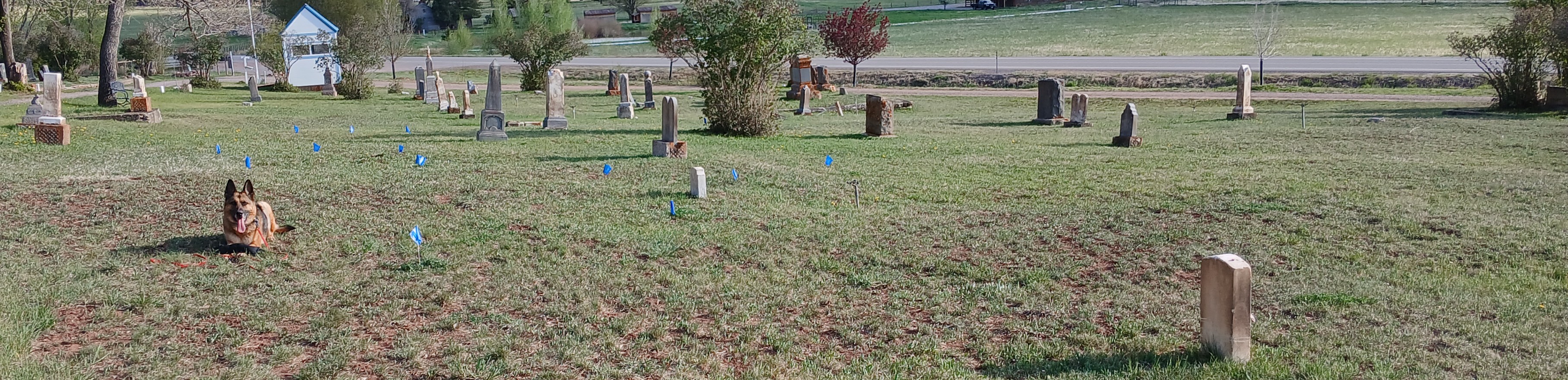
An aerial view of a dog and handler working across a dry autumn meadow.

Detection Dog Capabilities

An Annotated Bibliography of Supporting Literature

Peer-reviewed research, reference works and grey-lit on what trained detection dogs can do, organized by application area.

Canine Olfaction: The Underlying Science

Craven, B.A., E.G. Paterson, and G.S. Settles

2010 The fluid dynamics of canine olfaction: Unique nasal airflow patterns as an explanation of macrosmia. Journal of the Royal Society Interface 7(47):933–943. https://doi.org/10.1098/rsif.2009.0490
This foundational sensitivity study established dogs' stable detection thresholds of roughly 1–2 parts per trillion for isoamyl acetate under controlled conditions. It is one of the most frequently cited baselines for canine odor detection thresholds.

Walker, D.B., J.C. Walker, P.J. Cavnar, J.L. Taylor, D.H. Pickel, S.B. Hall, and J.C. Suarez

2006 Naturalistic quantification of canine olfactory sensitivity. Applied Animal Behaviour Science 97(3-4):241–254. https://doi.org/10.1016/j.applanim.2005.07.009
Computational Fluid Dynamics (CFD) modeling of canine nasal airflow showing dogs separate respiratory and olfactory airflow, allowing continuous sniffing without losing scent resolution. This study describes the structural explanation for canine scenting superiority.

Archaeological & Historic Human Remains Detection (AHRDD)

Glavaš, V., and A. Pintar

2018 Human remains detection dogs as a new prospecting method in archaeology. Journal of Archaeological Method and Theory 26:1106–1124. https://doi.org/10.1007/s10816-018-9406-y

Grebenkemper, J., A. Morris, B.F. Byrd, and L. Engbring

2021 Applying canine detection in support of collaborative archaeology. Advances in Archaeological Practice 9(3):226–237. https://doi.org/10.1017/aap.2021.12

Skowronek, R., E. Cecil, S. Hammond, W. Kirsch, P. Lamson, A. Morris, B. Peabody, and L.C. Pierce

2006 Going to the dogs: Human remains detection dogs in archaeology. Indian Journal of Physical Anthropology and Human Genetics 25(2):151–166.
These three peer-reviewed sources establish HRD dogs as a valid prospecting method in archaeological contexts (old, buried, and unmarked burials), distinct from modern forensic search work.

Supporting grey literature

Baxter, C.L., and M.L. Hargrave

2015 Guidance on the use of historic human remains detection dogs for location of unmarked cemeteries. Information Bulletin. U.S. Army Corps of Engineers.

Bureau of Land Management (BLM)

2012 The use of dogs to detect subsurface prehistoric human remains in an archaeological context. Information Bulletin No. CA-2012-009. U.S. Department of the Interior, Bureau of Land Management, Sacramento.

Kindt, M.

2026 Detection dog trained final response distance from burial: A GIS assessment of archaeological human remains detection dogs' trained final responses in relation to geophysical evidence of burials in four historic cemetery sites. Undergraduate paper, Colorado Mesa University. Paper presented at the Annual Meeting of the Colorado Council for Professional Archaeologists, Golden, Colorado.

Martin, P.S., and J.M. Sullivan

2009 Best practices for the use of cadaver dogs to locate cold case, historical, and pre-historical burials. Invited paper, Canine Section, National Conference for the National Association for Search and Rescue, Little Rock.
2009 The science behind voodoo magic: Understanding the human decomposition scent spectrum and the use of cadaver dogs to locate historic and pre-historic human burials. Paper presented at the Mississippi Archaeological Association Conference, Clarksdale.

Martin, P.S.

2011 User's guide to cadaver dog teams. Paper presented at the 2011 Mountain, Swamp, and Beach Regional Forensic Anthropology Meeting, Clemson.

Martin, P.S., B.R. Tormey, K.M. Reda, and R.C. Nelsen

2012 Dog versus machine: Exploring the utility of cadaver dogs and ground penetrating radar in locating human burials at historic archaeological sites. Poster presented at the 61st Annual Meeting of the Southeastern Section of the Geological Society, Asheville.

Martin, P.S., B.R. Tormey, J.M. Sullivan, and C.A. Schultz

2019 Geophysics to cadaver dogs: Multi-method approach to surveying historical cemeteries. Paper presented at the 68th Annual Meeting of the Southeastern Section of the Geological Society of America, Charleston.

Martin, P.S., and L. Lee

2023 Key factors impacting the efficacy of canine resources on archaeological surveys. Paper presented at the 88th Annual Meeting of the Society for American Archaeology, Portland.

Forensic Human Remains Detection & Search and Rescue

Alexander, M.B., T.K. Hodges, J. Bytheway, and J.A. Aitkenhead-Peterson

2015 Application of soil in forensic science: Residual odor and HRD dogs. Forensic Science International 249:304–313.
Documents dogs' ability to detect residual human decomposition odor in soil even after remains have been removed.

Alexander, M.B., T.K. Hodges, D.J. Wescott, and J.A. Aitkenhead-Peterson

2016 The effects of soil texture on the ability of human remains detection dogs to detect buried human remains. Journal of Forensic Science 61(3):649–655.
Real-world, discipline-specific factor study showing how soil composition affects the strength and behavior of the scent signature dogs are working with underground, a topic that is important in working-practitioner knowledge as part of doing AHRD work responsibly and well.

Cablk, M.E., and J.C. Sagebiel

2011 Field capability of dogs to locate individual human teeth. Journal of Forensic Sciences 56(4):1018–1024.

Komar, D.

1999 The use of cadaver dogs in locating scattered, scavenged human remains: Preliminary field test results. Journal of Forensic Sciences 44(2):405–408.

Lasseter, A.E., K.P. Jacobi, R. Farley, and L. Hensel

2003 Cadaver dog and handler team capabilities in the recovery of buried human remains in the southeastern United States. Journal of Forensic Sciences 48(3):617–621. https://doi.org/10.1520/JFS2002296

Vass, A.A.

2012 Odor mortis. Forensic Science International 222(1-3):234–241. https://doi.org/10.1016/j.forsciint.2012.06.006

Vass, A.A., R.R. Smith, C.V. Thompson, M.N. Burnett, D.A. Wolf, J.A. Synstelien, and N. Dulgerian

2004 Decompositional odor analysis database. Journal of Forensic Science 49(4):1–8.

Vass, A.A., R.R. Smith, C.V. Thompson, M.N. Burnett, N. Dulgerian, and B.A. Eckenrode

2008 Odor analysis of decomposing buried human remains. Journal of Forensic Science 53(2):384–391.
The Vass and Alexander studies together document the chemistry behind HRD: the specific decomposition volatiles dogs are keying on, how they persist after remains are removed, and how soil conditions shape that signature underground.

Decomposition & soil science

Cablk, M.E., E.E. Szelagowski, and J.C. Sagebiel

2012 Characterization of the volatile organic compounds present in the headspace of decomposing animal remains, and compared with human remains. Forensic Science International 220(1-3):118–125. https://doi.org/10.1016/j.forsciint.2012.02.007

Carter, D.O., and M. Tibbett

2008 Cadaver decomposition and soil: Processes. In Soil Analysis in Forensic Taphonomy, edited by M. Tibbett and D.O. Carter, pp. 29–51. CRC Press, Boca Raton. https://www.routledge.com/Soil-Analysis-in-Forensic-Taphonomy-Chemical-and-Biological-Effects-of-Buried-Human-Remains/Tibbett-Carter/p/book/9781420069914
Book on soils. Carter's chapter is specifically on how soil processes shape decomposition, complementing the Alexander et al. soil texture/residual odor studies above.

Carter, D.O., D. Yellowlees, and M. Tibbett

2007 Cadaver decomposition in terrestrial ecosystems. Naturwissenschaften 94:12–24. https://doi.org/10.1007/s00114-006-0159-1
Widely cited review of how bodies decompose in soil and how that process interacts with the surrounding ecosystem. This is a foundational reading for the "why" behind residual and buried-remains odor.

Forbes, S.L., B.H. Stuart, and B.B. Dent

2005 The effect of the method of burial on adipocere formation. Forensic Science International 154:44–52. https://doi.org/10.1016/j.forsciint.2004.09.109
Adipocere ("grave wax") is a long-lasting decomposition byproduct that can persist for decades; directly relevant to what an older or archaeologically aged burial may still be chemically producing.

Janaway, R.C., S.L. Percival, and A.S. Wilson

2009 Decomposition of human remains. In Microbiology and Aging: Clinical Manifestations, edited by S.L. Percival, pp. 313–334. Springer, New York. https://doi.org/10.1007/978-1-59745-327-1_14
General reference chapter on the microbiology of human decomposition. This is useful background reading on the process generating the odor compounds documented in the Vass and Statheropoulos-type studies above.

Schotsmans, E.M.J., W. Van de Voorde, J. De Winne, and A.S. Wilson

2010 The impact of shallow burial on differential decomposition to the body: A temperate case study. Forensic Science International 206:e43–e48. https://doi.org/10.1016/j.forsciint.2010.07.036
Case study on how burial depth changes decomposition rate and pattern, offering a relevant context for how deeply buried remains (a major variable in both forensic and archaeological HRD work) affect the scent signature over time.

Statheropoulos, M., C. Spiliopoulou, and A. Agapiou

2005 A study of volatile organic compounds evolved from the decaying human body. Forensic Science International 153(2-3):147–155. https://doi.org/10.1016/j.forsciint.2004.08.015
One of the first systematic characterizations of the volatile organic compounds released during human decomposition, identifying many of the chemical markers later incorporated into Vass's decompositional odor database.

Statheropoulos, M., A. Agapiou, E. Zorba, K. Mikedi, S. Karma, G.C. Pallis, C. Eliopoulos, and C. Spiliopoulou

2011 Combined chemical and optical methods for monitoring the early decay stages of surrogate human models. Forensic Science International 210(1-3):154–163. https://doi.org/10.1016/j.forsciint.2011.02.023
A follow-up work tracking how that VOC profile shifts across the early stages of decomposition, using controlled surrogate models rather than a single snapshot.

Stokes, K.L., S.L. Forbes, and M. Tibbett

2013 Human versus animal: Contrasting decomposition dynamics of mammalian analogues in experimental taphonomy. Journal of Forensic Sciences 58:583–591. https://doi.org/10.1111/1556-4029.12115
Similar territory to the Cablk et al. 2012 study above: examines where animal decomposition analogues match (and diverge from) human decomposition dynamics. This is a useful context for handlers to evaluate HRD training-aid science.

Supporting grey literature & reference works

DeGreeff, L.E., and C.A. Schultz

2022 Canines: The Original Biosensors. Jenny Stanford Publishing, New York.

Gerritsen, R., and R. Haak

2015 K9 Scent Training: A Manual for Training Your Identification, Tracking and Detection Dog. Dog Training Press.

Jezierski, T., J. Ensminger, and L.E. Papet

2016 Canine Olfaction Science and Law: Advances in Forensic Science, Medicine, Conservation, and Environmental Remediation. CRC Press, Boca Raton.

Judah, C., and T.C. Sargent

2015 How to Train a Human Remains Detection Dog. CreateSpace.

Osterkamp, T.

2020 Detector Dogs and Scent Movement: How Weather, Terrain, and Vegetation Influence Search Strategies. CRC Press, Boca Raton.

Rebmann, A., E. David, and M.H. Sorg

2000 Cadaver Dog Handbook: Forensic Training and Tactics for the Recovery of Human Remains. CRC Press, Boca Raton.

Warren, C.

2015 What the Dog Knows: Scent, Science, and the Amazing Ways Dogs Perceive the World. Touchstone/Simon & Schuster, New York.

And Dogs Can Do a Lot More

Medical & Disease Detection

Catala, A., H. Cousillas, M. Hausberger, and M. Grandgeorge

2018 Dog alerting and/or responding to epileptic seizures: A scoping review. PLOS ONE 13(12):e0208280. https://doi.org/10.1371/journal.pone.0208280
Review of owner-reported cases finding alerting accuracy of roughly 70–85%, with dogs alerting anywhere from 10 seconds to 5 hours ahead of seizure onset.

Feil, C., F. Staib, M.R. Berger, T. Stein, I. Schmidtmann, A. Forster, and C.C. Schimanski

2021 Sniffer dogs can identify lung cancer patients from breath and urine samples. BMC Cancer 21:917. https://doi.org/10.1186/s12885-021-08651-5
Double-blind clinical trial in which a single trained dog correctly identified 40 of 41 lung cancer patients from combined breath/urine samples (97.6% detection rate); breath samples alone outperformed urine samples alone.

Half, E., A. Ovcharenko, R. Shmuel, S. Furman-Assaf, M. Avdalimov, A. Rabinowicz, and N. Arber

2024 Non-invasive multiple cancer screening using trained detection canines and artificial intelligence: A prospective double-blind study. Scientific Reports 14:28204. https://doi.org/10.1038/s41598-024-79383-2
Largest published trial to date (1,386 participants); a combined canine/AI screening platform detected breast, lung, prostate, and colorectal cancer from breath samples with 93.9% sensitivity and 94.3% specificity, and also flagged several cancer types it was not specifically trained to detect.

Hardin, D.S., W. Anderson, and J. Cattet

2015 Dogs can be successfully trained to alert to hypoglycemia samples from patients with type 1 diabetes. Diabetes Therapy 6:509–517. https://doi.org/10.1007/s13300-015-0135-x
Demonstrates dogs can be reliably trained to discriminate hypoglycemic scent samples from normal ones.

Soggiu, F., J. Sabbatinelli, A. Giuliani, R. Benedetti, A. Marchegiani, F. Sgarangella, A. Tibaldi, D. Corsi, A.D. Procopio, S. Calgaro, F. Olivieri, A. Spaterna, R. Zampieri, and M.R. Rippo

2023 Sensitivity and specificity of in vivo COVID-19 screening by detection dogs: Results of the C19-Screendog multicenter study. Heliyon 9(5):e15640. https://doi.org/10.1016/j.heliyon.2023.e15640
Multicenter study reporting canine COVID-19 screening performance in the 82–97% sensitivity / 83–100% specificity range across the six highest-quality studies reviewed — comparable to or exceeding rapid antigen tests.

Narcotics & Explosives Detection

de Miranda-Magalhães, A.J., G.M. Jantorno, A.Z. Pralon, M.B. de Castro, and C.B. de Melo

2023 Explosive detection dogs: A perspective from the personality profile, selection, training methods, employment, and performance to mitigate a real threat. Animals 13(24):3773. https://doi.org/10.3390/ani13243773
Comprehensive review of explosives-detection-dog capability and the selection/training standards behind operational reliability; cites canine detection thresholds reaching parts-per-trillion concentrations.

Rice, B.L., and J. Velasco

2023 Comparing narcotics detection canine accuracy across breeds. Heliyon 9(8):e19040. https://doi.org/10.1016/j.heliyon.2023.e19040
Compared 34 narcotics dogs (25 Belgian Malinois and 9 German Shepherds) and found no statistically significant difference in detection accuracy between the two breeds. (Note: the study only tested these two breeds, so it doesn't speak to narcotics-detection capability across breeds generally, only that Malinois and Shepherds performed comparably to one another.)

Wildlife & Conservation Detection

Cablk, M.E., and J.S. Heaton

2006 Accuracy and reliability of dogs in surveying for desert tortoise (Gopherus agassizii). Ecological Applications 16(5):1926–1935. https://doi.org/10.1890/1051-0761(2006)016[1926:AARODI]2.0.CO;2

Cablk, M.E., J.C. Sagebiel, J.S. Heaton, and C. Valentin

2008 Olfaction-based detection distance: A quantitative analysis of how far away dogs recognize tortoise odor and follow it to source. Sensors 8(4):2208–2222. https://doi.org/10.3390/s8042208
Together, the Cablk studies quantify detection range and field accuracy for a live, protected wildlife species.

Glover, N.J., L.E. Wilson, A. Leedale, and R. Jehle

2023 An experimental assessment of detection dog ability to locate great crested newts (Triturus cristatus) at distance and through soil. PLOS ONE 18(6):e0285084. https://doi.org/10.1371/journal.pone.0285084
Demonstrates detection dogs can locate a small, protected amphibian species both at a distance and through soil cover.

Grimm-Seyfarth, A., W. Harms, and A. Berger

2021 Detection dogs in nature conservation: A database on their world-wide deployment with a review on breeds used and their performance compared to other methods. Methods in Ecology and Evolution 12(4):568–579. https://doi.org/10.1111/2041-210X.13560
Analysis of a database of 1,220 publications (916 scientific) covering wildlife detection dog deployments in 62 countries and 476+ target species. Detection dogs outperformed other survey methods in 88.7% of documented cases. (This is the source for cross-breed capability claims because it covers 108+ FCI-classified breeds working as detection dogs across targets, compared the narcotics study above.)